UNITY PLUGIN · C# · TEAM OF 3
////////
Sparse Voxel Octree Navigation
OctNav: a Unity plugin that carves navigable space out of arbitrary geometry at runtime, then runs A* through it for ground and airborne agents alike. The object at the top of this page is the same idea.
The problem
Most pathfinding ships on a navmesh, and a navmesh is a surface. The moment an agent leaves the ground — a drone, a flying enemy, anything with a jump worth the name — a surface stops describing where it can go. A uniform 3D grid describes volume, but it pays for every cubic metre of empty air at the same rate it pays for the geometry that matters.
Why an octree
A sparse voxel octree only spends memory where there is detail. Space starts as one cell; cells that intersect geometry subdivide, recursively; cells that don’t stay whole and cheap. The result is a lattice that hugs the surface of the world — dense where the world is dense, almost free where it’s empty.
That trade is the entire point, and it’s visible: the object on this site’s front page is a real sparse octree built over a mesh in your browser, and the node count in the corner of the hero is the actual count. Empty cells never subdivide.
What the plugin does
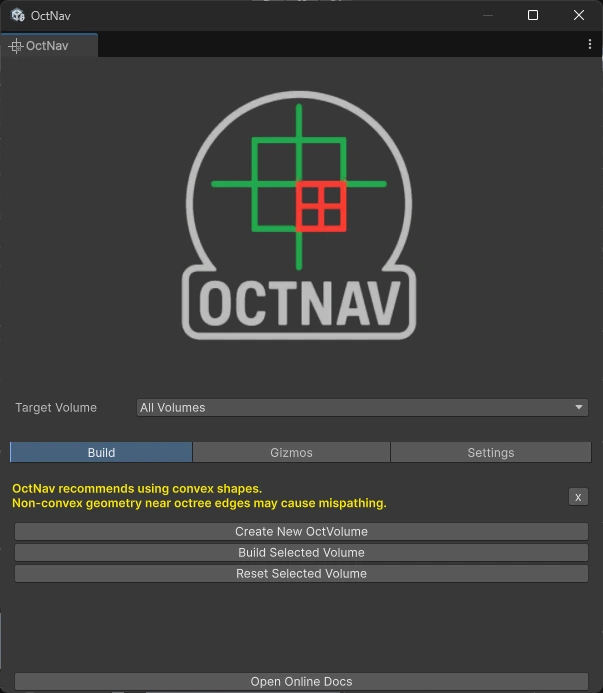
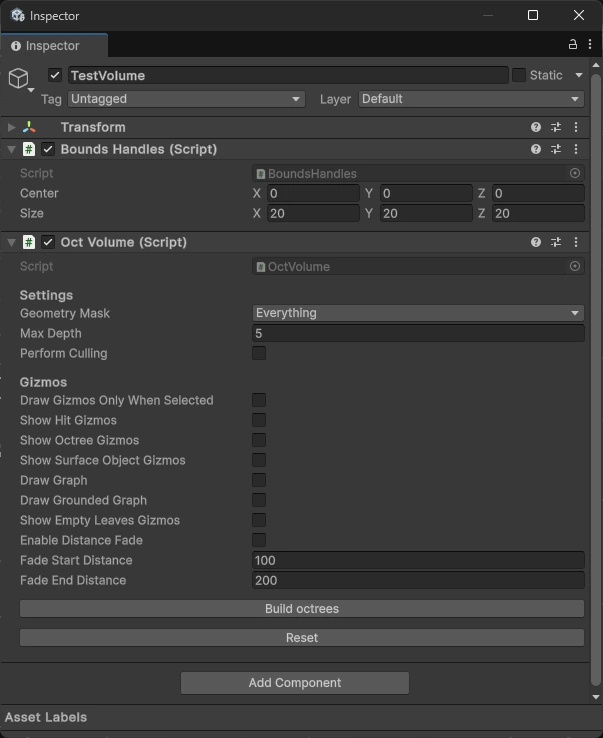
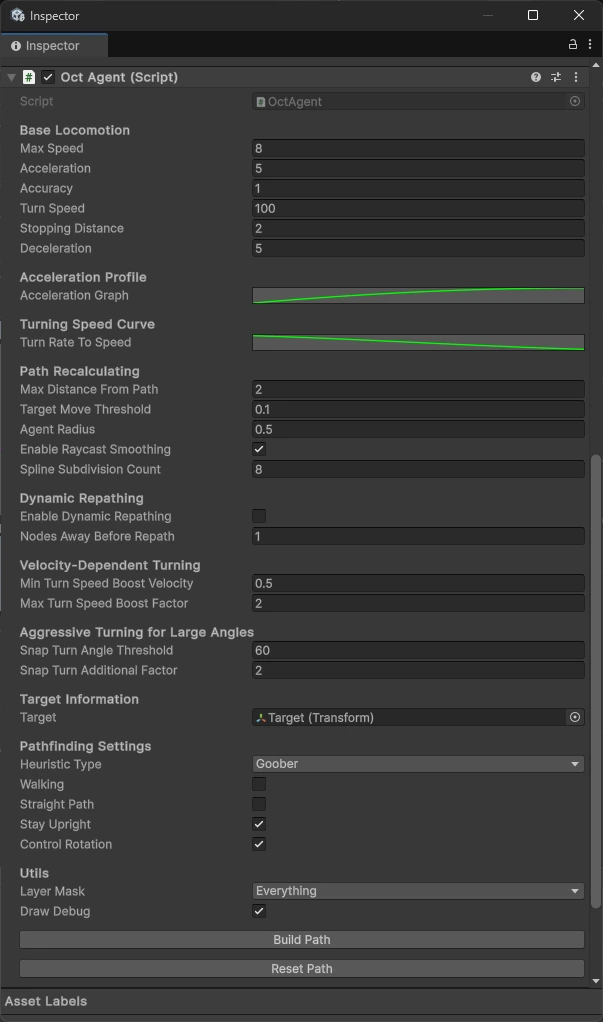
We built it as a Unity package, OctNav, with an editor window, scene gizmos and two components — a volume and an agent:
- Runtime octree generation over arbitrary geometry (
BuildChildren()), with a geometry mask and per-volume max depth. No baking step required — and the built tree can be saved and loaded as JSON so a shipped scene skips the build entirely. - Two graphs from one tree: empty leaves and their face links form the volumetric A* graph for airborne agents; collision cells with clear space above them form the grounded graph, with steps and edges handled, for walkers.
- Partial rebuilds (
BuildSection(bounds)): when the world changes, only the cells inside the changed bounds are re-subdivided and re-linked — not the whole tree. - A* solved off the main thread: a
ThreadedPathfindingservice runs each solve as a task over a snapshot of the graph, so agents never stall the frame while thinking. - Selectable heuristics — Manhattan and Euclidean, plus a set of
in-house ones (
Morrisium,Goober,Andradian, and up-biased variants for agents that prefer altitude) — with dynamic repathing when the path is invalidated or the target moves. - Path smoothing: raycast smoothing to cut redundant corners, and spline subdivision so agents don’t hug voxel centres — with locomotion tuned by acceleration and turn-rate curves, velocity-dependent turning and snap turns for large angles.
Status
A university project, built as a Unity plugin in C# by a team of three. It exists because we wanted to understand the structure properly — not read about it, build it. If you’d like to see it running, email me and I’ll show you.